

Final Fantasy Resonance Review
As the first "new" turn-based Final Fantasy game in years, there is a lot that I genuinely love about Final Fantasy Resonance. It's an experiment that largely succeeds in harnessing the nostalgic feel of classic Final Fantasy while pushing it in bold new directions. The combat and Visions system is an unequivocal success, and easily one of the best turn-based battle systems we've seen in the last decade. The surprisingly large ensemble cast is quirky and lovable, filling the game with heart-warming moments.
And yet, as good as all that is, there are just a couple of crucial pieces missing. Chief among those is a lack of a core to Resonance's story really being about something, or having anything meaningful to say. As much as I like many of the characters along the way, ultimately, Resonance's narrative sputters out near the end and mostly falls flat in the realm of sidequests as well. What results is a Final Fantasy game that looks and plays fantastically, but feels more vapid than it should.
Part of what has always made Final Fantasy special, in my mind, is how each game has uniting themes to its world and characters. Final Fantasy 7 links the concept of human identity to a dying world and ecological conservation. Final Fantasy 9 is entirely about existentialist dread and what it means to be alive. Final Fantasy 10 is about the dangers of religious dogma and how that shapes people's lives and society as a whole. There are obviously deeper intricacies you can dissect within each game's themes, but there's always a larger concept that you explore with a Final Fantasy title. This even applies to some spinoff games that are ostensibly about "nostalgia"; just look at the way Stranger of Paradise asks shockingly large questions about what it means to be a Final Fantasy game and how the series has shaped the genre as a whole.
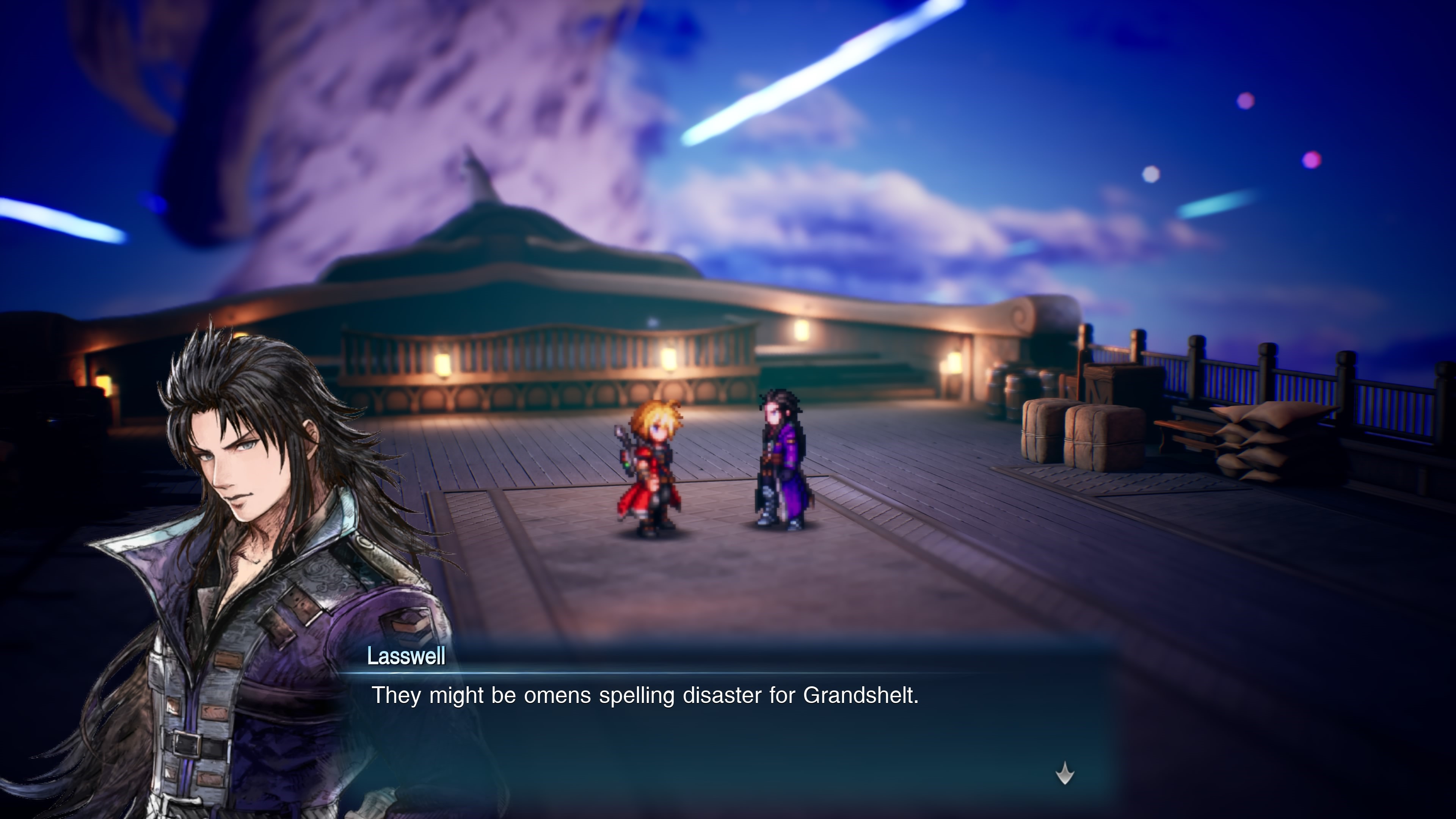
Therein lies my core problem with Final Fantasy Resonance, and what I mean when I say the game isn't really about anything. Part of that stems from the fact that this game is entirely built on the story and structure of the mobile game Final Fantasy Brave Exvius — but there's no strong thematic core to dig into. There are themes, of course, like any story, but they are largely isolated to specific character arcs. What all that means is you have a story that comes out of the gate strong, and even has a really good mid-section, but it ultimately sort of sputters to the end in the last third.
Following in the footsteps of Octopath Traveler 0, Final Fantasy Resonance completely reconstructs Brave Exvius as a single-player RPG, making generous changes to the story and structure of the mobile game along the way. And to get one thing out of the way, this is essentially a new single-player Final Fantasy in every way, intentionally designed to feel like a follow-up to the 16-bit era of the franchise: turn-based battles, a world map to explore, an airship to unlock, optional bosses, and everything else in between.
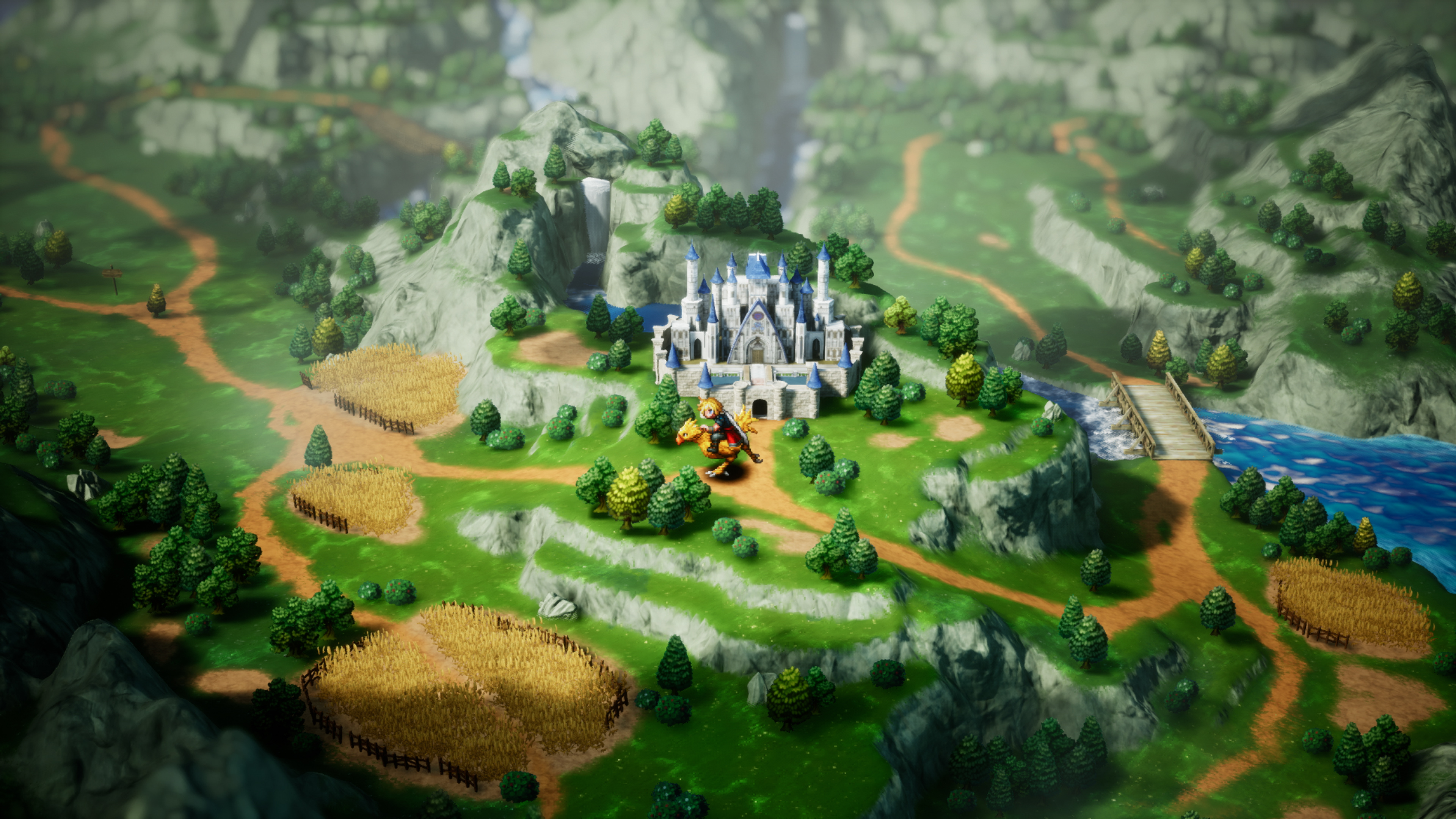
To get an easy positive out of the way, the presentation for Final Fantasy Resonance is consistently impressive, and never stops being so. Each and every environment is lavishly created, character sprites are lavishly brought to life with a wealth of animations, and the handful of high-quality cutscenes spread across the game are nothing short of stunning. There's a really smart visual language that runs throughout Final Fantasy Resonance, uniting all of the disparate areas of the game through similar visual tendencies, all of which harken back to that golden era of Final Fantasy. Equally, Resonance's soundtrack, as anyone who's played Brave Exvius will know, is just as stunning, filling the game with a vibrant sense of whimsy.
The visual and auditory presentation comes together so well, in fact, that I'd say it's a big part of what pushes Resonance into being more than the sum of its parts. For example, even dungeons that are something of a slog to play through, gameplay-wise, are still a treat to experience because of that presentation. And the fluidity of animation in combat especially helps everything feel smooth and snappy. Even after 40 hours with Resonance, I was still finding myself impressed by how well this game uses the HD-2D style.
In Resonance, you follow the story of Rain and Laswell, two young knights of the Kingdom of Grandshelt. When a mysterious organization called the Sworn Six shatters Grandshelt's magic crystal, the pair set out on a journey around the world to save the rest of the world's crystals, lest a prophecy be fulfilled about the world falling to ruin when all eight crystals are destroyed. Rain and Laswell recruit a ragtag band of heroes from the world's various countries along the way, from the brilliant airship inventor Lid to a rebel hero named Jake who has an inherent penchant for flirting.
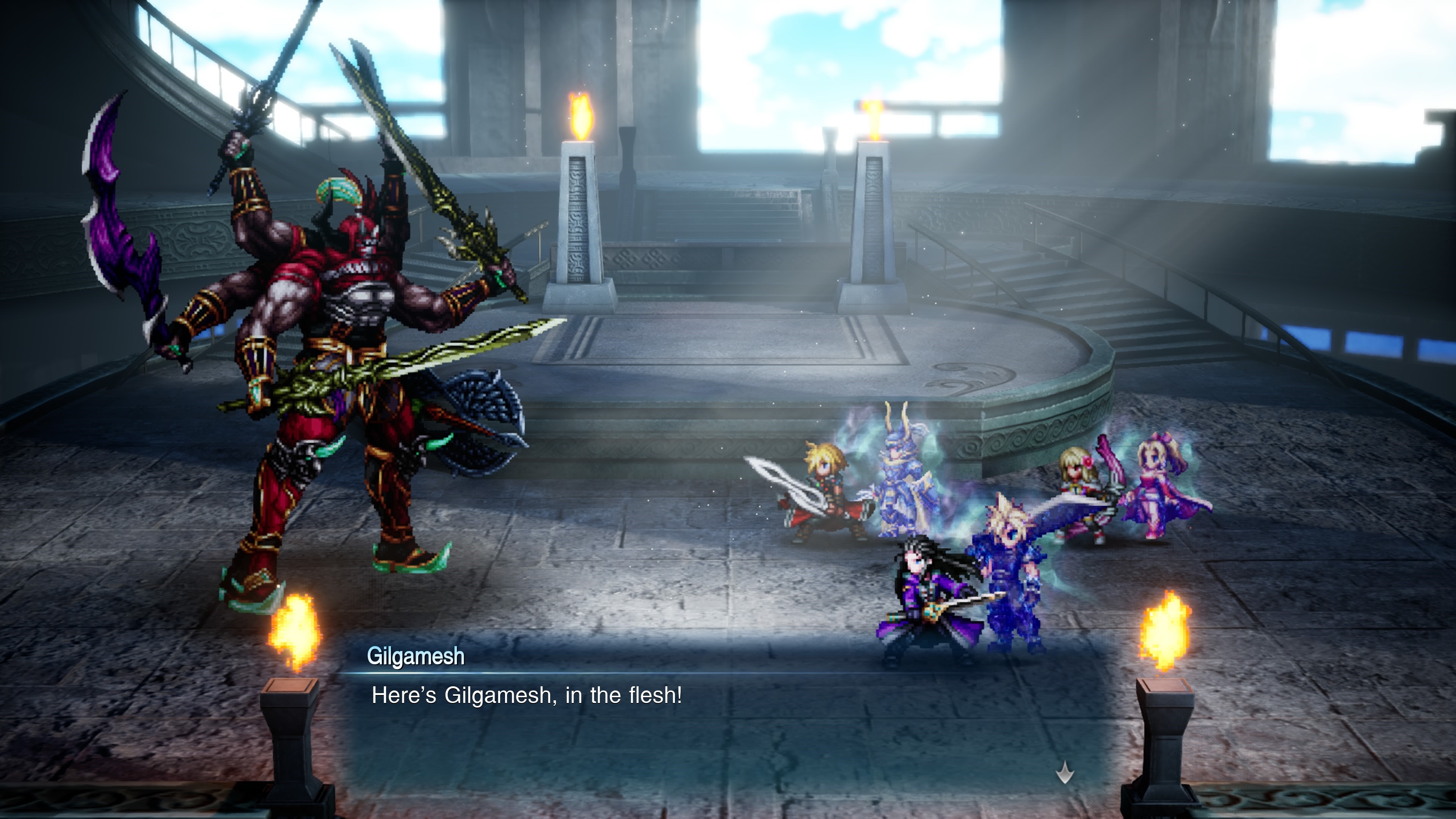
Resonance is arguably more character-focused than even most mainline Final Fantasy games, as the crux of its story, and the various sidequests, entirely revolve around that main cast of characters. That makes sense considering the basis for Resonance is a mobile gacha game, which usually centers new storylines around new characters. Essentially, as you travel to each new continent, you're playing through a dedicated character arc for one new party member, and then sidequests continue those arcs as the main story continues progressing. The good news is that, by and large, the main cast is inherently likable and bounces off each other well.
These dynamics between characters are constantly at play, even in the main story, from the feuding rivalry of Rain and Laswell, to the way the stoic mage Nichol constantly acts as the voice of reason. Strong voice acting across the board also helps instill these characters with a lot of unique personality, and on that point, what's really interesting is that Resonance seemingly takes some heavy inspiration from another RPG franchise, Bandai Namco's Tales. There are points in Resonance where I almost felt like I was playing a Tales game in terms of how these party dynamics play out. Resonance even obviously cribs the Tales series' iconic skits, with little optional conversations you can play while exploring, typically focused on more funny or gag elements of character relationships. But the strong character writing of Resonance helps keep a rather generic main story moving at a brisk pace, even if Rain, as the main character, is the least interesting character in the game, with the least meaningful growth.
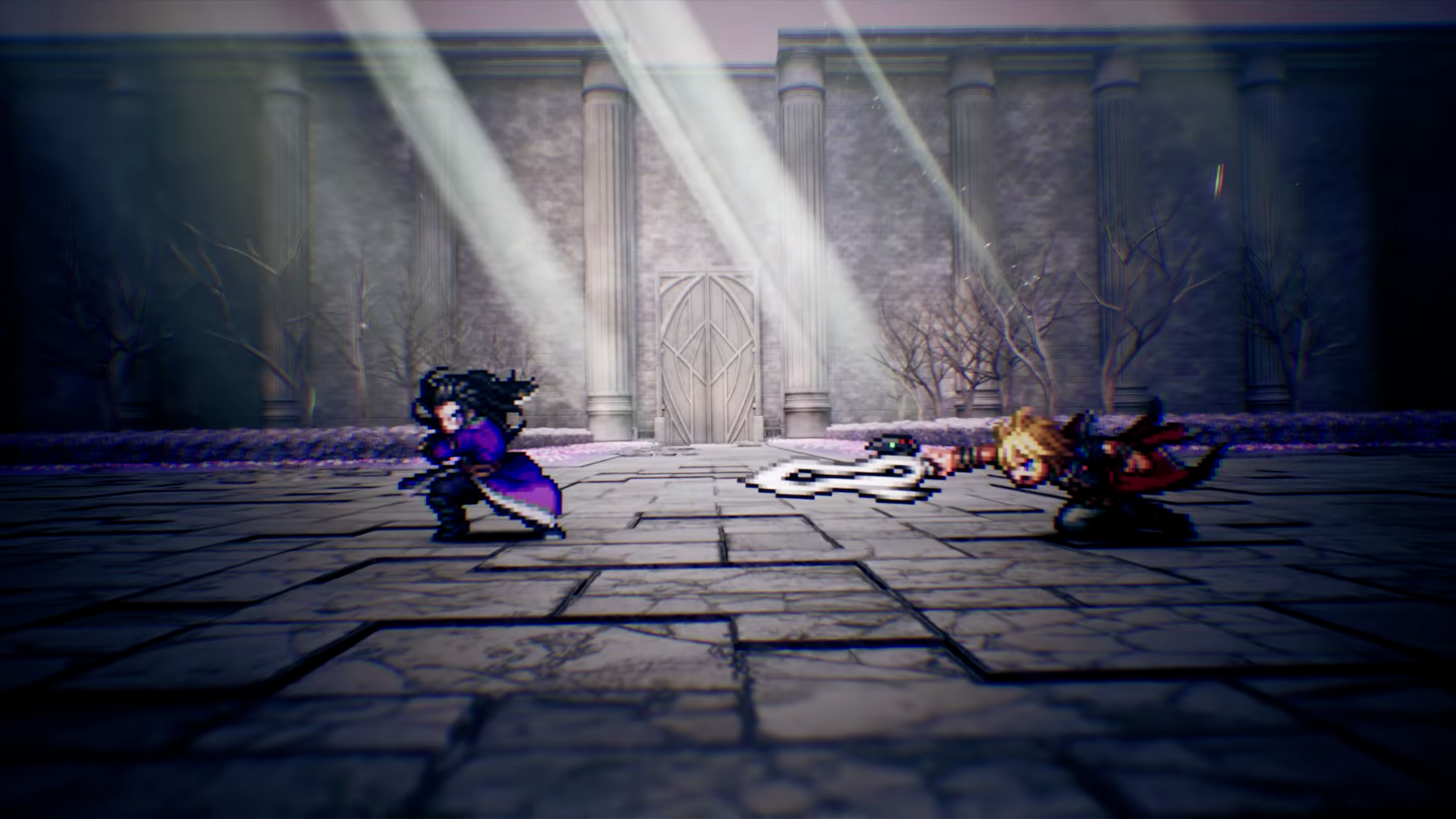
Pacing is an interesting aspect, however. As I noted earlier, the beginning and middle section of Resonance are strong, with a core mystery that unravels at a decent clip, and the addition of new party members to constantly shake things up. Once the full party is assembled, however, and you hit the final stretch of the game, things really slow down. That lack of a core thematic message is a problem, but I also just generally think Resonance really loses steam in the last 5-10 hours by bogging you down with boss gauntlets, lengthy dungeons, and quests that have you bouncing back and forth between destinations.
What's even more bizarre, though, is that sidequests are almost the inverse of this. For the first half, sidequests are entirely uninteresting, relegated to mostly simple fetch quests, or weird little one-off gag stories that don't land all that well. But right as the main story starts to slow down, there's a marked shift in the quality of sidequests, with each party member getting their own dedicated quests that dive deep into their character and place in the world — on top of some ancillary quests that really help flesh out the mythos of this world. There's practically a distinct point where you can see the quality of sidequests shift, and where the things I enjoyed about Resonance's storytelling started inverting.
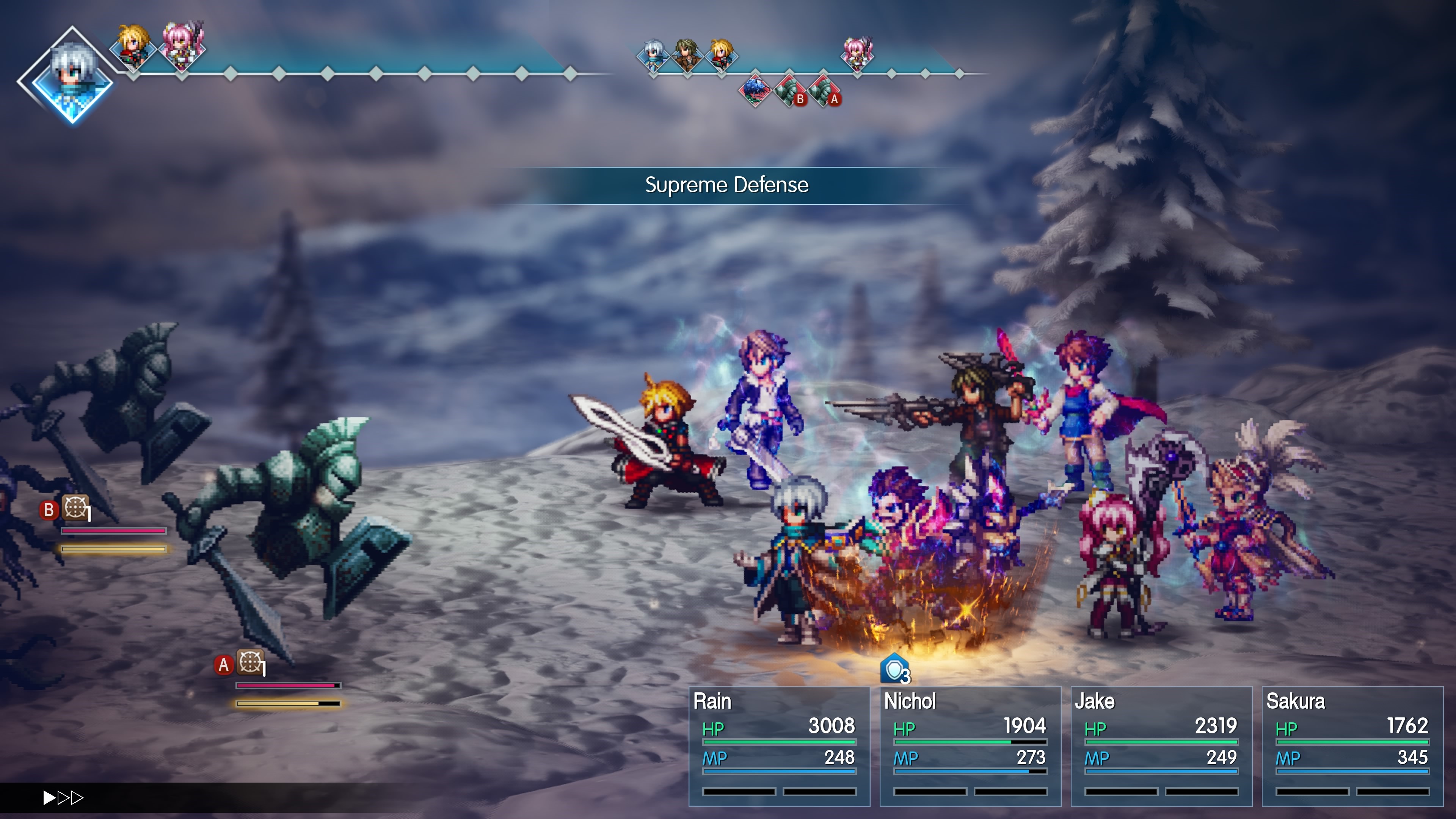
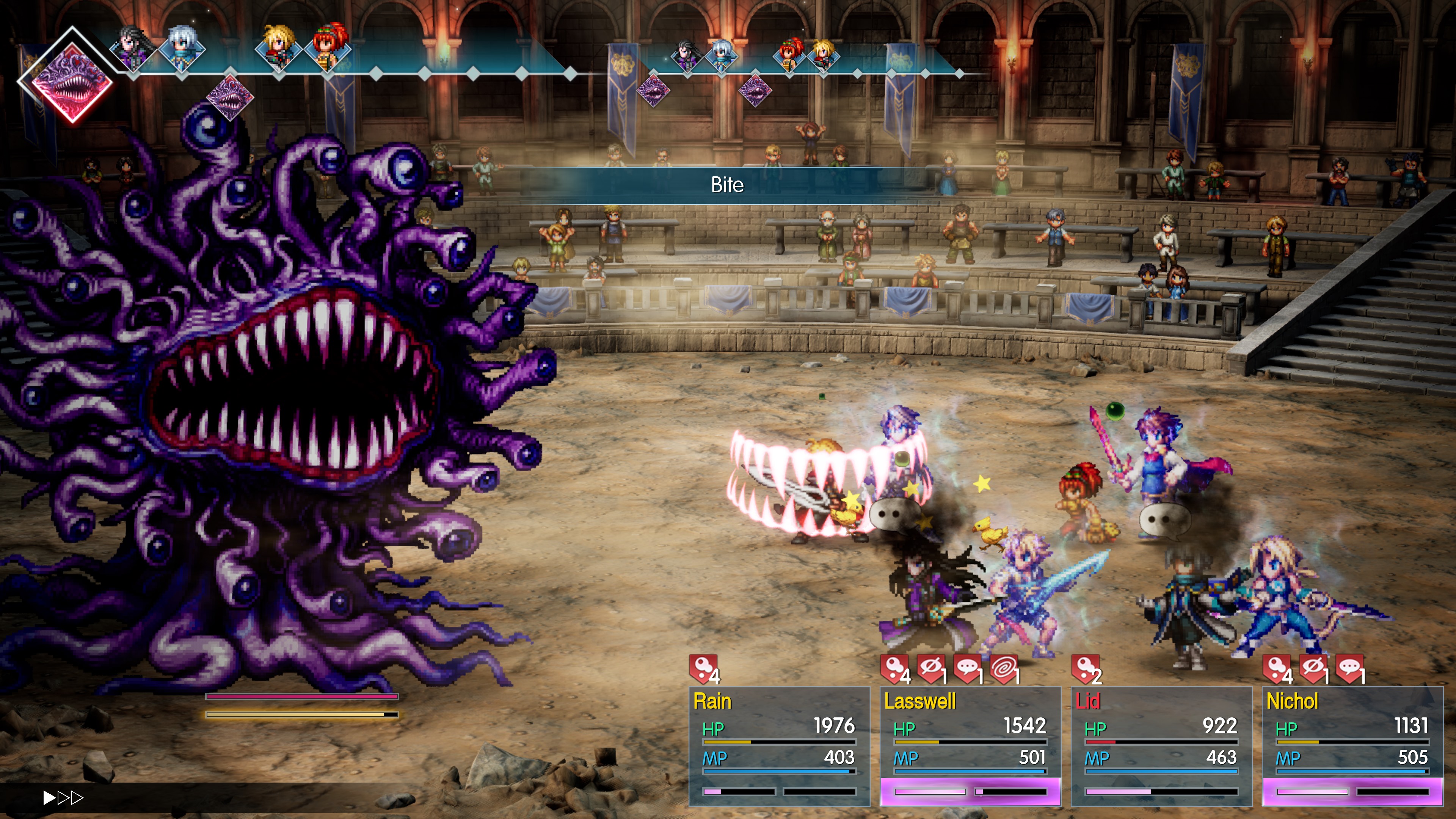
While the story might flip-flop and stumble here and there, the aspect I can say is an unequivocal success the entire way through is Resonance's combat system, a legitimately genius combination of the likes of Final Fantasy V and Final Fantasy VI, and hands-down one of the best turn-based systems seen in years. Resonance smartly takes the weakness exploitation and break system of the Octopath games, and fuses that with the more traditional role systems of the series, an ultimately winning combination. Final Fantasy turn-based systems typically fall into two camps, job systems and specialized characters, but Resonance seeks, and mostly succeeds, to fuse those two disparate elements through the use of "Visions" that are past Final Fantasy characters and original ones.
Essentially, each party member has a pre-set role in combat: Rain is a Commando that acts like a tank, Nichol is a buffer that supports the party while exploiting enemy weakness, Fina is a Medic that heals the party while specializing in light magic, etc. As characters level up, their stats increase, and they unlock new skills. But in tandem with those specialized characters are Visions you can equip on each party member, secondary characters that basically act as a job system.
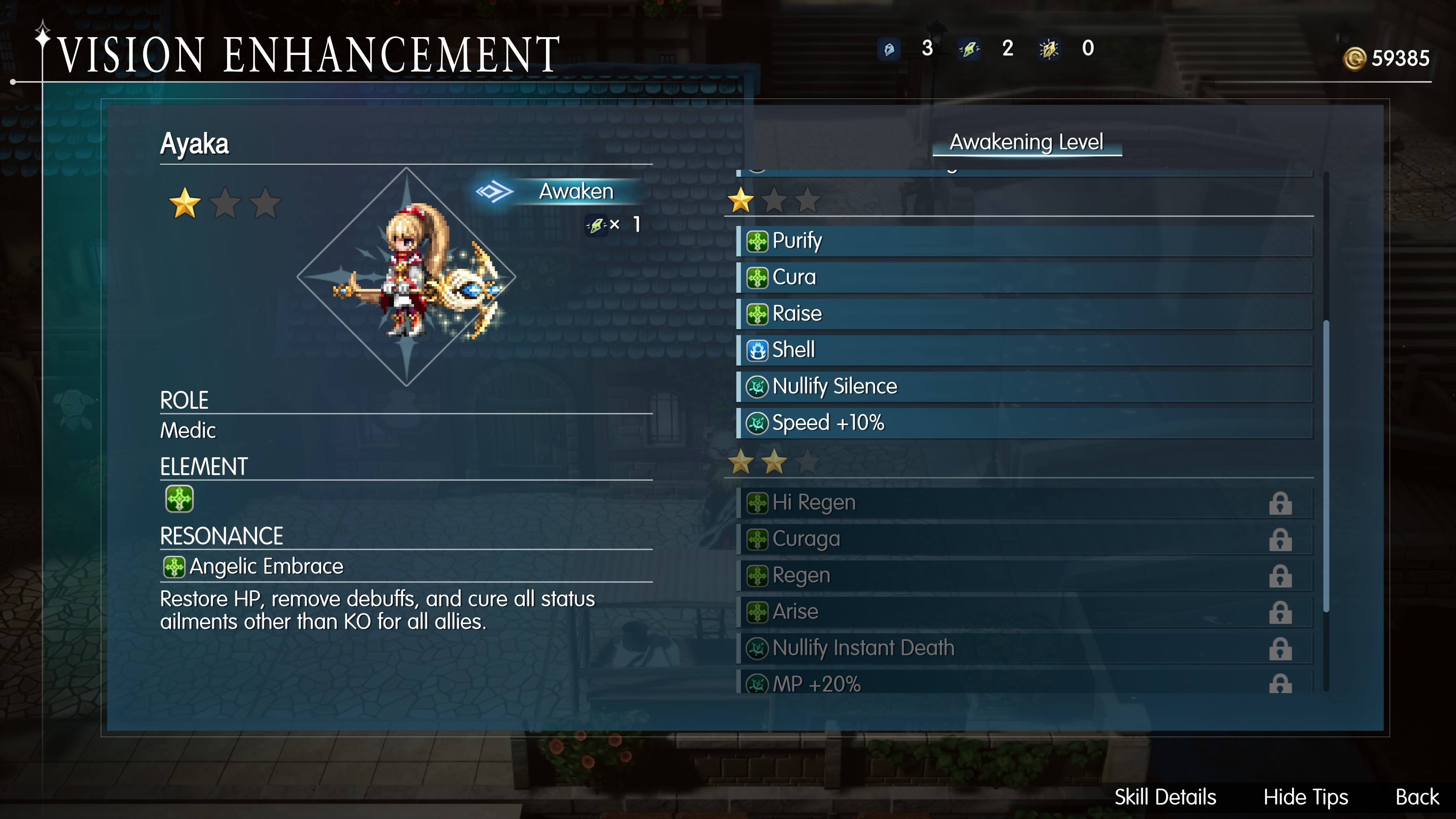
Each Vision comes with its own set of abilities and skills, and has two different components: Awakening Level and Mastery Bonuses. Awakening Level can be raised by using Magicite you find throughout the world, and each rank unlocks a new slew of skills for battle. Meanwhile, Mastery is essentially your job level, gaining experience in each battle. As Mastery goes up, you permanently unlock skills for the character that has that Vision equipped; sometimes these are stat bonuses and sometimes specific abilities that you can equip using Ability Points. And the effect these abilities can have can be huge. For example, Firion's Arms Akimbo lets you use two commands in one turn, while Tidus' Tip-Top Shape increases the physical damage you deal based on the amount of buffs a character has.
This all likely sounds pretty complicated on paper, and it initially is a lot to wrap your head around, but it ultimately provides a staggering amount of flexibility in how you build each specific character and your party as a whole. But even more deeply, I found myself adoring the flexibility in how this system lets you basically plan out character progression. I found myself thinking three steps ahead in terms of which Visions I wanted to put on which characters, and which specific abilities I wanted from each. I could turn Rain into a tank that soaks up damage, then gets a massive boost to his damage output when enemies are staggered. Nichol became an essential part of my party with his constant buffs, which I altered even further with Visions, while also stapling on some nifty healing abilities. And Laswell became a fighter laser-focused on staggering the enemy, with a cavalcade of skills to whittle that bar down to zero, using nearly every elemental attack in the game.
It's nothing short of joyous how much control Resonance gives you over its battle system, let alone how many options it gives you to literally break it wide open. Because new Visions are layered in across the entire experience, it feels like you're constantly getting a new puzzle piece that alters the shape of everything, or a new toy to play around with. Coupled with this is the fact that Resonance constantly gives you interesting new bosses and enemies to fight, ones that play around with the rules of the weakness system or sport some kind of new gimmick that shakes things up. These constantly put your strategies to the test, and force you to take a look at your party build, shake up your equipment and Visions, and try things again.
There's a good sense of scaling to the difficulty level as well, slowly ramping things up in the first half before really laying on the accelerator in the second. But there are also three different difficulty levels to switch between if you need more, or less, of a challenge, and these difficulties do feel quite a bit different, in a positive way. Even across 45-ish hours with Final Fantasy Resonance, I never grew tired of the battle system, and I felt invested in continuing to build my characters into these unstoppable behemoths. That truly is the mark of a good battle system, when I've finished the game, and I'm still hungry for more.
In lieu of games like last year's Clair Obscure: Expedition 33, it feels like Final Fantasy Resonance is a good reminder of the breadth of possibility in turn-based games, and how rich you can make even a seemingly basic system when you really allow players to dig into the mechanics behind it. The sheer variability in how you control Resonance's systems is what makes this battle system sing.
There's a larger feeling that developed for me while playing Final Fantasy Resonance: the idea that what's here is good, but boy, this is really a rock-solid foundation for something entirely new. As someone who played Brave Exvius back in the day and enjoyed it quite a bit, I was hoping that there'd be more substantial and meaningful changes to the story. The overall narrative of Brave Exvius isn't bad, but certainly a bit derivative, and was intentionally designed to feel "nostalgic" by embracing many of the tropes Final Fantasy has become known for. As a mobile gacha game, that was fine, and even helped the game excel in some ways. But as a single-player RPG, I think a more generous brush could have been taken to spruce things up in Resonance, in that regard. At the same time, the combat system and overall presentation are genuinely brilliant on every level. It's the kind of game that I wholeheartedly enjoyed every minute of, but once the credits rolled, I struggled to find any way the thing really stuck with me.
As it stands, Final Fantasy Resonance feels a bit like comfort food, that fast food meal that you order, and boy does it taste good. But you're not going to remember that meal months or years down the road — not like that local Italian scratch kitchen I ate at only once and still think of whenever I get Italian food. Final Fantasy Resonance is solid to great in nearly every way, but it just lacks that singular thematic spark that elevates Final Fantasy games from good to something truly legendary.
I think the most crucial point here possibly is the foundation that Resonance creates, and how my mind is already latching onto the tantalizing ways a brand-new Final Fantasy game could capitalize on it. The stunning presentation and phenomenal combat alone more than justify a return to this style of game, but I'd love to see something not bound by the trapping of what's come before.
Final Fantasy Resonance is certainly a success in taking the series back to its roots, but the key now is if Square Enix can figure out how to build a meaningful future on top of that foundation. With the right emphasis on what works about Final Fantasy Resonance, there could be something truly special ahead.